Big Tech's AI budget keeps getting bigger.
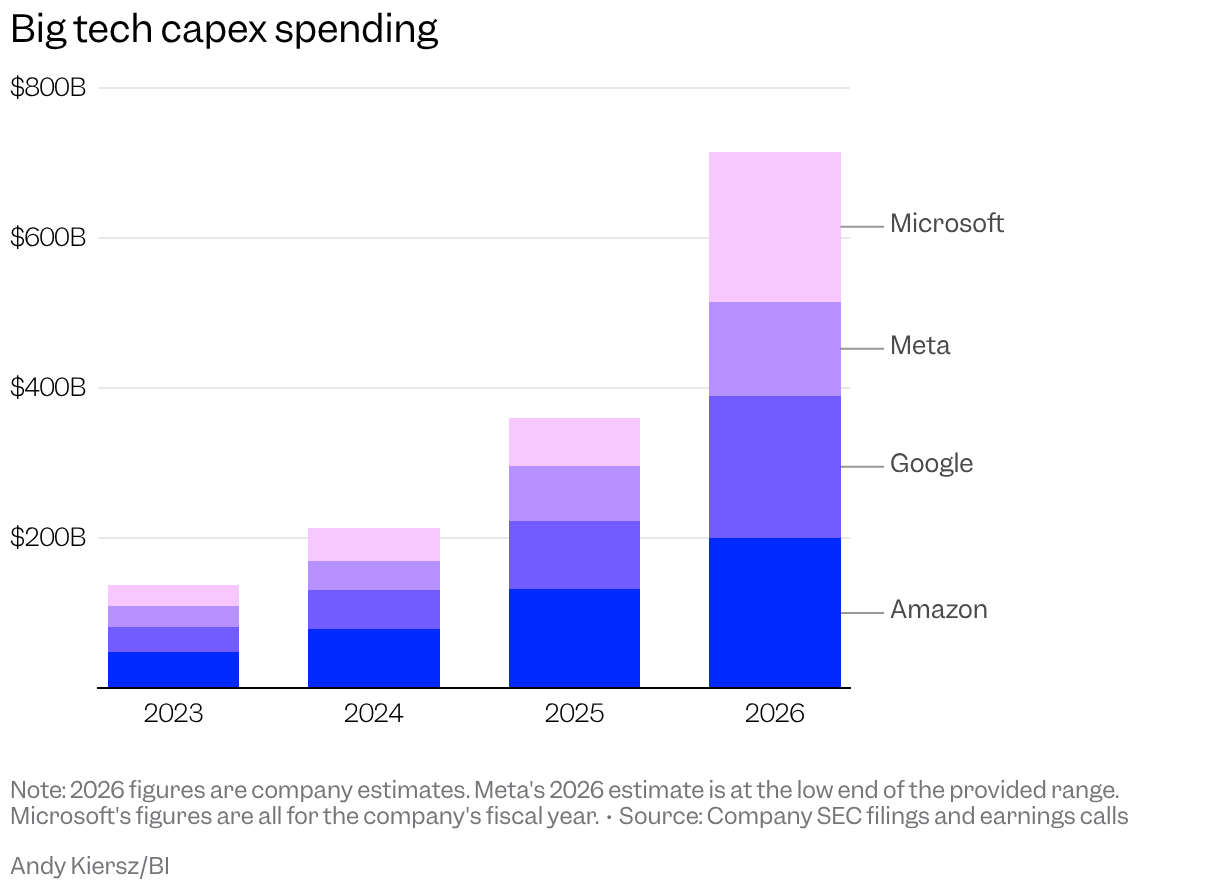
Amazon, Microsoft, Meta, and Google are now planning to spend up to $725 billion on capital expenditures in 2026, investors learned on Wednesday's first-quarter earnings calls.
The latest total is roughly $100 billion more than the projections they made in the previous earnings for 2026.
The biggest surprise came from Microsoft, which announced plans to spend $190 billion on capex this year. Meta increased its forecast to up to $145 billion, while Google shared a revised top-end forecast of $190 billion. Amazon did not update its $200 billion estimate.
Big Tech's capex spending has risen to historic levels in the last year as the companies race to spend billions on the property and equipment needed to power artificial intelligence.
When questioned by wary investors about the creeping spend, executives on the calls were firmly enthusiastic.
"We remain confident in the return on these investments," Microsoft CFO Amy Hood said.

Microsoft's $190 billion forecast is a big jump from analysts' estimates of $147 billion. Now, Microsoft's capex guidance is nearly as high as the $200 billion its rival Amazon has said it will spend this year.
Microsoft's cloud revenue is growing, though not quite as fast as investors would like, especially given power and supply chain constraints that slow the current pace of data center development.
She added that, with the additional investment, the company still expects short-term revenue growth to be constrained. Microsoft also plans to decrease its head count in the coming quarters.
It reported $31.9 billion in capex this past quarter, up from $21.4 billion the same quarter last year.
Amazon is in a similar boat. While the company did not update its full-year capex guidance, CEO Andy Jassy reassured investors that the investment would be worth it.
"We have high confidence this will be monetized well, as we already have customer commitments for a substantial portion of it," Jassy said.
Amazon spent $43.2 billion in capex for AWS and generative AI this past quarter, up from $24.3 billion the same time last year.
Jassy said the company is prioritizing efficiency and expects that using Trainium, Amazon's in-house chips, will give the company an edge in profit margins.
Google, which is investing heavily in its AI models, updated its full-year capex guidance range to $180 billion to $190 billion, up from its earlier forecast of $175 billion to $185 billion.
The company plans to "significantly increase" capital expenditures in 2027, though it did not provide a specific figure.
Google spent $35.7 billion on capex this quarter, up from $17.2 billion the same time last year.
The company's cloud platform is facing a $462 billion backlog.
"We are compute-constrained in the near term, and cloud revenue would have been higher if we had been able to meet the demand," said Sundar Pichai, CEO of Google parent company Alphabet.
Meta spent $19.8 billion on capital expenditures, up from $13.7 billion in Q1 of 2025.
The company adjusted its full-year capex guidance range to $125 billion to $145 billion. It previously estimated $115 billion to $135 billion.
"Most of that is due to higher component costs, particularly memory pricing, but every sign that we're seeing in our own work and across the industry gives us confidence in this investment," CEO Mark Zuckerberg said.
He said the company is focused on increasing efficiency through its Meta Compute initiative.
"We are rolling out more than one gigawatt of our own custom silicon that we're developing with Broadcom, as well as a significant amount of AMD chips to complement the new Nvidia systems that we're rolling out as well," Zuckerberg said.

