Markets

SpaceX's mega rally is hitting its first stumble

SpaceX Chief Financial Officer Bret Johnsen  in the center and President Gwynne Shotwell to his right celebrate as they ring the opening bell at the Nasdaq MarketSite to celebrate the launch of SpaceX's initial public offering.
SpaceX executives celebrate the company's record-breaking IPO on Friday. TIMOTHY A. CLARY / AFP via Getty Images
Read in app

SpaceX's post-IPO mega-rally has hit its first slowdown.

Shares in Elon Musk's rocket company, which raised a record $75 billion when it went public last week, had dropped nearly 5% on market close on Wednesday, its first down day since the offering on June 12. The slide continued on Thursday, with the stock down 10% to $172.11. Shares are still up 27% from the IPO price of $135.
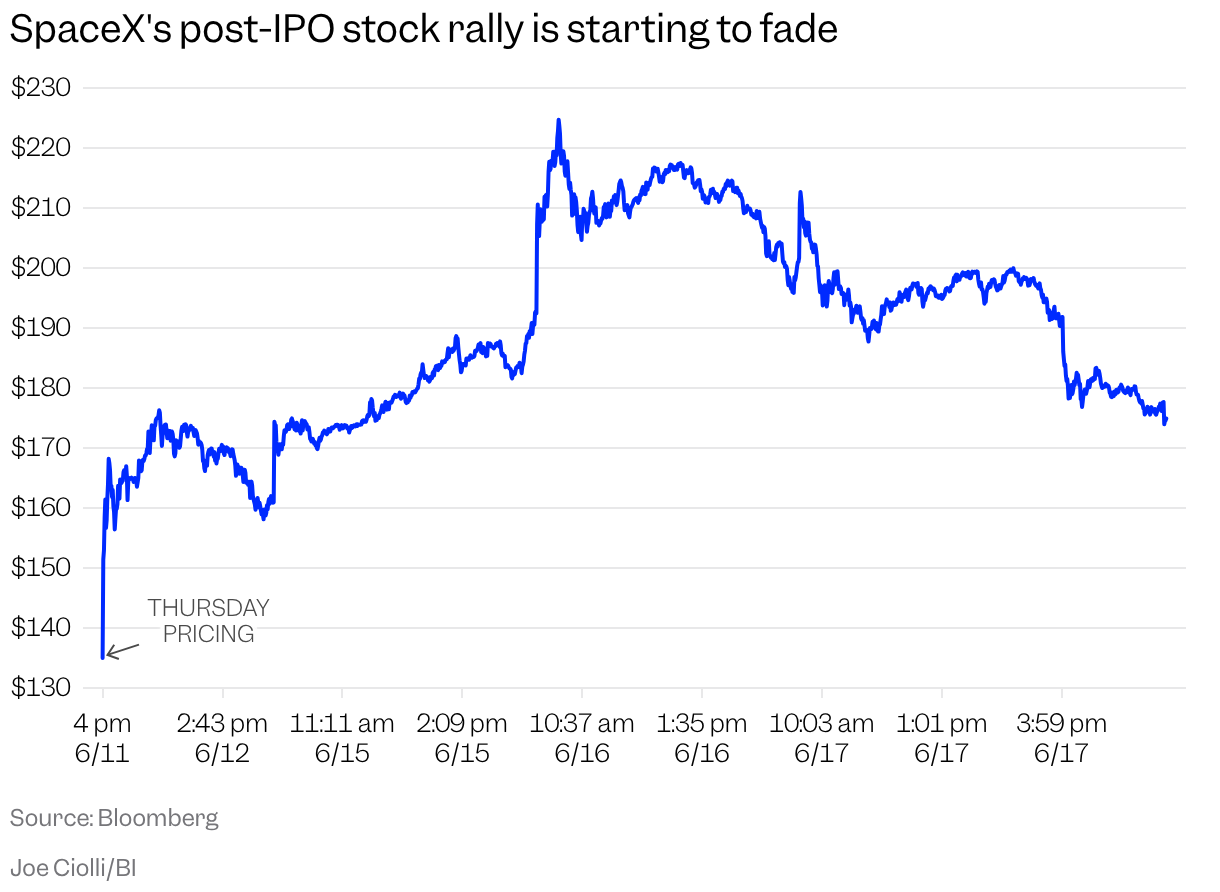
The drop ended a monster share price rally that had seen SpaceX's market cap soar to nearly $3 trillion in its first days of trading, eclipsing Amazon as the world's fifth most valuable company and cementing Musk's status as the world's first trillionaire.

The company enjoyed a nearly flawless debut on the public markets, with shares popping 19% on their first day of trading amid feverish enthusiasm from retail investors and Wall Street institutions.

SpaceX has been busy since its history-making IPO, announcing a $60 billion deal for AI coding startup Cursor on Tuesday.

The all-stock acquisition, which saw SpaceX exercise an option to purchase Cursor that it agreed to in April, is a sign of how the company is utilizing its post-IPO surge. Pershing Square founder Bill Ackman said the deal cost "materially less in dilution" due to SpaceX's high valuation.

SpaceX's valuation had been questioned by some analysts in the run-up to the IPO. The company posted a $4.9 billion loss in 2025 on revenue of $18.7 billion, way below the revenue recorded by other multi-trillion-dollar tech giants like Google and Amazon.

SpaceX, which also absorbed Musk's AI startup xAI in February, is betting on new markets for AI data centers in space to drive growth.

The company told investors that its total addressable market was worth $28.5 trillion, roughly the size of US GDP in 2024. On Sunday, Musk said that SpaceX's revenue may reach $1 trillion by 2030.

Read next

Tom Carter headshot
Tom Carter
Tom Carter is a Reporter at Business Insider's London office, covering tech with a focus on EVs, self-driving cars, and robotics.His work includes deeply-reported features, breaking news, and scoops on some of the world’s largest companies. He has written extensively on some of the biggest themes in the auto industry, including the rise of China’s EV giants and Tesla’s pursuit of autonomous vehicles, and has interviewed CEOs and executives from several major companies. Tom can be reached at tcarter@businessinsider.com, or securely at tcarter.41 on Signal.  My reporting: Exclusive: Ford employees have been told they could be fired if they don't follow the company's RTO mandateExclusive: Stellantis is rolling out a 5-day return-to-officeExclusive: GM has hired a former Tesla exec in its revived self-driving pushExclusive: Tesla rival Polestar closes R&D sites in the UK and lays off 130 staffInside BYD's plan to rule the wavesAustin is the new capital of the robotaxi warsTesla has flirted with disaster before. This time feels different.Inside the quest to bring Tesla's Cybertruck to EuropeBYD's largest megafactory dwarfs Tesla's. Satellite images show it's getting even bigger.I was a remote worker at Google. I quit after the company refused to let me move to take care of my dad.
Headshot of author
Samuel O'Brient
Samuel O'Brient is an experienced financial markets and business journalist who has written extensively on a wide range of topics involving economics, technology and public policy. At Business Insider, he covers important macro and micro economic stories, including takes from leading economists and hedge fund managers, breaking IPOscorporate bankruptcies, meme stocks and short-selling. He also writes on other markets such as crypto, oil and real estate.He has interviewed many of the market’s most influential voices, ranging from top economists such as Mark Zandi and Richard Thalerto prominent investors including Danny Moses, Andrew Left, Anthony Scaramucci, Louis Navellier and Grant Cardone.Programs such as LiveNOW from Fox and Taking Stock have had Samuel on to discuss stock market developments. His reporting has been cited by The New York Times DealBook, Bloomberg Radio, Forbes, Entrepreneur and TheFutureParty.Samuel began at InvestorPlace, covering investing, retail trading and macro economic trends. Prior to joining Business Insider,  he served as a technology markets reporter at TheStreet. He is a graduate of Sarah Lawrence College and Trinity College Dublin.Samuel's work has appeared in publications such as TipRanks, EV and Observer. When he isn't chasing down stories, he can often be found browsing book and record shops. To reach Samuel, email him at sobrient@insider.com or connect with him on LinkedIn. He is also on Signal as Samuel Clemens. Popular Articles: A Nobel economist has a warning for meme stock tradersThe business school dropout who kicked off the Beyond Meat rally wants you to know he's not Roaring Kitty 2.0A top economist who thinks we're on the brink of a recession says he's eyeing these 3 warning signsTrump's 401(k) executive order marks big changes for retirement savings — and possibly puts your money at riskWhy hedge fund icon Ray Dalio says you shouldn't invest in real estate in this economyAI bullishness is soaring, but pros see a major opportunity brewing in an overlooked corner of the market